Friday, November 27, 2009

Super Fun Waves In Fading Swell

The miserably wretched first hour of my nearly four hour session this afternoon, played counterpoint to an incredible final hour and half surfing in the best Fall waves I've scored yet.

My plan was for a redux of yesterday in smaller surf, but a lower tide. I thought YH would be holding some small but good waves. Wrong. Disappointingly inconsistent, small, low energy goiters waddled through the line-up and over the reef, usually right through a path of chain mail kelp intend on slamming you face first onto the deck of your board. Side shore winds were blowing me out of the line-up. And the occasional rain squall felt like I should be in the mountains with a snowboard under my feet instead of a SUP. The demons of negativity took over. I stood my ground as long as I could before throwing in the towel and heading over to Sarge's. I thought maybe I could score a couple decent waves, reclaim the session and call it a day. An inauspicious beginning.

On the upside...there were fewer people at Sarge's by the time I got there. As per my usual, I lined up wide and picked off a few stragglers no one else was taking. Overall, the surf was better at my new locale. Never more than seven people out and as the afternoon moved into evening, the waves just got better...and better...and better. And more consistent too. I was the last one out of the water, and spent 20 minutes on a literal merry-go-round to end the session. Those last half hour of rides were long ones too, from the rip-rap point to past the nudie beach or to the seawall, about 200 yards. After I kicked out or faded over the back of the wave, I slowly paddled back out to the line-up. In that last 20 minutes, I never waited more than 30 seconds for the next wave. At ten after five it was too dark for my eyes and I rode the white water as far in as I could for the take out.

At least part of the explanation for the increase in wave size and consistency lies in the data below. The passing front that brought light rain and wind to the coast, brought some heavy NW winds (29-37 mph) blowing down coast. That kicked up some amazingly well groomed nearshore wind swell driven waves, along with the remnants of the last NPAC ground swell.

After three consecutive days, eight hours of SUP surfing, and waves too numerous to count, my shoulders and legs are stressed and fatigued to the max. Tomorrow has to be a rest day. Gotta rest up for the next swell.

November 27, 2009
In: 1325
Out: 1715
AT= 59-53F
WT= 54F
Wx: Scattered showers and clouds with periodic clearing
Tide: 1.16' Rising to 2.8'
Wind: Strong side shore and offshores
Sea Surface: Wind ripples and scallops with some light backwash bump late
10-0 Angulo EPS/Epoxy Custom SUP with Infinity Ottertail carbon fiber paddle
Fin set-up: Thruster with K2D2 4.75" center fin (first mark up from back) and RFC Speedwings
Bathymetry: Rock reefs
Deep Water Swell and Wave Face Heights CDIP Archive
Buoy: NWS (Farshore #1-Nearshore-Farshore #2)
Time-NDBC Data-CDIP Data (Primary Swell Dir.)(Local Wave Ht. Avg.)
1300: 10.2 feet @ 16.0 WNW - 7.2 feet @ 14.3 W (295) (1-2 ft. faces)
1400: 10.2 feet @ 14.8 WNW - 6.6 feet @ 15.4 W (295) (3-4 ft. faces)
1500: 10.2 feet @ 16.0 WNW - 6.9 feet @ 15.4 W (295) (3-4 ft. faces)
1600: 9.2 feet @ 14.8 WNW - 6.9 feet @ 15.4 W (290) (3-5 ft. faces)
~New Wind Swell~
1700: 13.1 feet @ 14.8 NW - 6.6 feet @ 15.4 WNW (285) (4-6 ft. faces)
1800: 14.4 feet @ 10.0 NW - 8.5 feet @ 10.5 W (305) (4-6 ft. faces)
1900:
18.4 feet @ 10.0 NW - 10.5 feet @ 11.1 W (305) (4-6 ft. faces)

Thursday, November 26, 2009

Thanksgiving Wave Feast with Ground Swell Pie

Ma Nature served up a hefty portion of NPAC ground swell today. Although a bit on the inconsistent side by the time I got to it, the crowd scene was almost perfect.

I paddled out on the Angulo custom SUP after finishing an early dinner with the family at Maries. Good food in a great atmosphere and...no DISHES! (That was, I mean, used to be, my job!) There was a little wait in between sets, but 3-5 ft. fast walls were the order of the day. The most exposed spots had the biggest waves of course.

I started out at Yellow House, even though the tide was too high. Still, I caught three or four fun waves there before paddling back up to Sarges. By now (4PM) the crowd had dwindled to four. I spent the rest of my time taking down some very fun and fast waves off the point and off the wall. Zach had been out since 12:30...Marathon Man. At 1650 I was the last man out. I took two really good waves and then one last one in. They say there's more coming....

November 26, 2009
In: 1525
Out: 1715
AT= 62-56F
WT= 53.4F
Wx: Clear and sunny with cold front clouds moving in
Tide: 2.69' Rising to 3.32'
Wind: Light offshore
Sea Surface: Light wind ripples with some backwash bump
10-0 Angulo EPS/Epoxy Custom SUP with Infinity Ottertail carbon fiber paddle
Fin set-up: Thruster with K2D2 4.75" center fin (first mark up from back) and RFC Speedwings
Bathymetry: Rock reefs
Deep Water Swell and Wave Face Heights CDIP Archive
Buoy: NWS (Farshore #1-Nearshore-Farshore #2)
Time-NDBC Data-CDIP Data (Primary Swell Dir.)(Local Wave Ht. Avg.)
1400: 12.1 feet @ 17.4 WNW - 6.9 feet @ 16.7 W (295) (3-5 ft. faces)
1500: 12.5 feet @ 17.4 WNW - 7.9 feet @ 15.4 W (290) (3-5 ft. faces)
1600: 10.8 feet @ 17.4 WNW - 7.2 feet @ 16.7 W (285) (3-5 ft. faces)
1700: 10.8 feet @ 16 WNW - 6.9 feet @ 15.4 W (290) (3-5 ft. faces)
1800: 11.2 feet @ 16 WNW - 7.5 feet @ 15.4 W (no data) (no data)

Wednesday, November 25, 2009

Fading Aleutians Swell in Perfect Fall Wx

Weather wise, it just doesn't get better than this during the Fall season. Even if the fading away north Gulf swell was completely gone, I would have paddled out. The day was just too beautiful to avoid or miss.

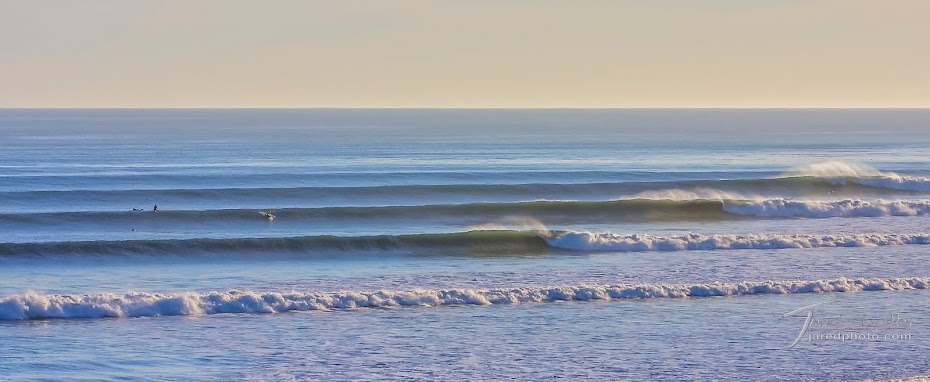
I waited for the tide to turn, knowing it would be small and inconsistent, hoping for a little tidal push that might spike wave heights. My almost two hour paddle surf started at Sarge's in a light to moderate WNW breeze, and ended surfing an inside reef down coast from GDubs. Sets were provided by the gulf swell, and a few in between smaller waves were thanks to local wind swell. Today was perfect for a SUP...cleaning up a lot of small waves on unpopulated reefs.

Even at a 2.5 foot plus tide rising, the kelp is super thick in spots. I got knocked off twice, and Paul, who was surfing with his son Will, got thrown off his board once. Later, Paul told me that Will just got sponsored by Source. Dad and son were surfing GDubs where Will was putting on a nose riding clinic. Will is just a wave catching machine, and I know he spent 80% of his standing time on the tip. He's doing well in competitions and who knows, maybe he'll be world champ one of these days.

Note: The one surf pic included here is an experiment with the Olympus camera. The cam is set to multiple frame shooting, zoomed in, asa at 400. I've had little luck getting good focus with the camera zoomed in on multiple frame. Today focus was better, but the images really grainy. More experimentation needed.

November 25, 2009
In: 1135
Out: 1325
AT= 61.4F
WT= 54F
Wx: Clear and sunny
Tide: 2.45' Rising to 2.75'
Wind: Light to moderate west northwesterlies
Sea Surface: Calm and mostly glassy
10-0 Angulo EPS/Epoxy Custom SUP with Infinity Ottertail carbon fiber paddle
Fin set-up: Thruster with K2D2 4.75" center fin (fourth mark up from back) and RFC Speedwings
Bathymetry: Rock reefs
Deep Water Swell and Wave Face Heights CDIP Archive
Buoy: NWS (Farshore #1-Nearshore-Farshore #2)
Time-NDBC Data-CDIP Data (Primary Swell Dir.)(Local Wave Ht. Avg.)
1100: 6.2 feet @ 16 NW - 3.6 feet @ 13.3 W (295) (2-3 ft. faces)
1200: 6.6 feet @ 12.9 NW - 3.3 feet @ 12.5 WNW (305) (2-3 ft. faces)
1300: 7.2 feet @ 13.8 NW - 3.6 feet @ 11.8 WNW (300) (1-3 ft. faces)
1400:6.9 feet @ 14.8 NW - 3.6 feet @ 12.5 WNW (300) (2-3 ft. faces)
1500: 6.2 feet @ 12.9 NW - 3.6 feet @ 13.3 WNW (300) (1-3 ft. faces)

Thursday, November 19, 2009

SUP-O-Rama Today; Wind & Rain Tomorrow

What a contrast between yesterday and today. This afternoon I surfed Sarge's small peelers at low tide. I posted up wide of the main peak which had about seven surfers taking turns riding the fairly consistent waves. Size was a little smaller than yesterday. From my staircase take-off venue I was on the merry-go-round for the full session. Things slowed a bit before dark (I was the last one out) but the payoff was that my final wave was the best wave of the day. It was dark enough so that all contrast was gone from the wave face. The dimly lit ride was punctuated not by the visual perception of speed, but by the vibratory "sound" of my fin reaching "hum" velocity, and the increase in speed that was felt, not seen. The falling lip cascaded off my hips as the board rocketed forward with bursts of speed and trim derived from expert design combined with my knowledge and familiarity of the Angulo custom SUP.

Teak was out on his longboard, one of the better surfers to surf Sarges kelpy, fast walls. It's always a pleasure to watch his graceful style, and the command he wields over his wave craft as he trims, stalls and noserides with ease. The mark of a good rider, he makes it look easy.

But the most startling difference between today's and yesterday's surf was surfing on the water instead of in it. Yesterday I was in full Winter wetsuit regalia. Today I downgraded to my 4/3 and cloth hood. Still I had on my booties and short sleeve Mysterioso shirt. And I put the heated vest on just in case. But I never used it. I got wet briefly one time, but the inside of my suit, and all undergarments were dry as a bone when I left the water. Yesterday after two hours, my hands were almost numb. Today after a little over an hour, it was as if I never went surfing. The difference between SUP and laydown surfing re the cold factor.

November 19, 2009
In: 1605
Out: 1715
AT= 62F to 55F
WT= 54.7F
Wx: Clear with some scattered clouds
Tide: .96' Falling to -0.07'
Wind: Light offshore
Sea Surface: Calm to light wind ripples
10-0 Angulo EPS/Epoxy Custom SUP with Infinity Ottertail carbon fiber paddle
Fin set-up: Thruster with K2D2 4.75" center fin (fourth mark up from back) and RFC Speedwings
Bathymetry: Rock reefs
Deep Water Swell and Wave Face Heights CDIP Archive
Buoy: NWS (Farshore #1-Nearshore-Farshore #2)
Time-NDBC Data-CDIP Data (Primary Swell Dir.)(Local Wave Ht. Avg.)
1500: 10.2 feet @ 13.8 NW - 6.2 feet @ 13.3 WNW (305) (2-3 ft. faces)
1600: 9.5 feet @ 13.8 NW - 5.9 feet @ 13.3 WNW (305) (2-3 ft. faces)
1700: 10.2 feet @ 13.8 NW - 5.2 feet @ 13.3 WNW (305) (2-3 ft. faces)
1800:9.8 feet @ 13.8 NW - 5.2 feet @ 14.3 WNW (300) (2-3 ft. faces)
1830: 10.2 feet @ 13.8 NW - 6.6 feet @ 13.3 WNW (no data) (no data)

Do The Math; Then Quit Surfing

Do The Math (An amateur's mathematical analysis of crowd phenomenon.)
By Steve Pezman (The Surfer's Journal - Online)

Roman AbacusIf you take the coast of California between San Francisco to the Mexican border, which is roughly 500 miles, and grossly estimate that there is one class “A” surf break every 50-miles, that would total 10. Then, say there is one class “B” break very 5-miles which adds 100 breaks to the total. Once again, let’s assume that there is yet another class “C” break every 5-miles to add another 100 breaks, making a grand total of 250, with, in truth, most of the surfers being drawn to the better third. Now, let’s say that there are 500,000 active surfers in California, and that on any sunny weekend day with a 4-foot swell running, that 10% will hit the surf. Now, let’s consider that at least 1/3rd of those 250 breaks will be completely off-duty due to swell direction. That makes for 50,000 surfers sharing 250-less 83 breaks=50,000/167 which means that on average, there will be 299 surfers for each working surf break along the coast between San Francisco and the Mexican border. Now let’s be real, the population is probably 2/3s in the south and 1/3 north, so the distribution at breaks would be weighted to the south. Therefore, let’s say 66% X 50,000 surfers=33,000 surfers for the working breaks in the south, and 17,000 for the working break in the north. Of course, quantifying “the better break attracting more than their share” theory means that, let’s say, 35,000 surfers surfing the top third working breaks (56) or about 625 for each of those which leaves only 15,000 for the other 111, or 155 per. In the real world, what actually happens is that over 500 surf Trestles during a day in roughly five shifts from dawn to dusk-the same at Malibu, and Huntington Pier and San Onofre, while most other breaks get way less. But any way you cut it the total mass of surfers and approximate number of surf breaks is undeniable. There could even be a cohesive mathematical theory hiding in this mess (Dick Hoye, are you there?). Mass=total human load factor, divided by the total number of breaks times 2/3s, times the average sets per/hr. times the average number of waves per set, multiplied by hours of sun light, times the price of gas? This is, of course, completely theoretical and statically askew, but the numbers don’t lie. We have outgrown our supply. -S.P.


TSJ (a surfing mag for more thoughtful grown-ups) recently debuted their new online magazine website. You can check it out for free, but in a couple months it'll only be available to magazine subscribers, of which I am one.

Wednesday, November 18, 2009

Mid-Period WNW Puts Up Small Waves

Oh yeah, now I remember. It's Fall. High tide in the morning, low tide at night. Not much goin' on for the dawn patrol...surfing until dark in the minus tides. Lots of Winter time, Winter swell reefs goin' off...haven't seen 'em in a year. Water gettin' cold, air temps warm up when it rains...more storms, more surf, blown out conditions. Head south. Stay home, get waves, SoCal shadowed all Winter long. Mind blowing sunsets at sea level.

Surfed the GB for almost two hours in, and around Sarges and Casa on a lowering to minus tide. There's enough west in the swell so that lots of winter reefs are working...not great, but surfable. The kelp is ubiquitous and looks real healthy. It should. Kelp loves cold water. Sometimes it slathers your board with itself on take-off. Press up, slip off 'cause kelp leaves are all over the push points.

Water temp was chilly, air temps not bad but cool. Light offshores. One young woman (hefty) out on a longboard in a bikini. I kid you not! She was out for an hour near dusk. She looked like she was having fun...yeah, if fun is freezing your okole off. (But she was pretty hefty...athletically speaking of course.)

On the way in Eric told me John gave a GhostBuster2 to Torey to try out. Eric said T got some killer rides using it as a kneeboard. Kneeboard, stand-up surf, bellyboard, or paipo...it's all good. One size (small) fits all. It ain't a shortboard, it's 60% of a longboard and built for fun.

November 18, 2009
In: 1535
Out: 1725
AT= 64-56F
WT= 54.9F
Wx: Sunny and clear
Tide: .75' Falling to -0.64'
Wind: Calm to light offshore
Sea Surface: Glassy
5-11 Freeline Ghost Buster 2 Mini-Simmons
Bathymetry: Rock reefs
Deep Water Swell and Wave Face Heights CDIP Archive
Buoy: NWS (Farshore #1-Nearshore-Farshore #2)
Time-NDBC Data-CDIP Data (Primary Swell Dir.)(Local Wave Ht. Avg.)
1500: 10.5 feet @ 12.9 NW - 6.9 feet @ 12.5 WNW (295) (2-4 ft. faces)
1600: 9.8 feet @ 13.8 NW - 6.2 feet @ 12.5 WNW (290) (2-4 ft. faces)
1700: 10.2 feet @ 13.8 WNW - 6.2 feet @ 13.3 WNW (290) (2-4 ft. faces)
1800: 10.5 feet @ 12.1 NW - 6.9 feet @ 13.3 WNW (295) (2-3 ft. faces)
1900: 9.8 feet @ 12.1 NW - 6.6 feet @ 14.3 W (295) (2-3 ft. faces)

Saturday, November 14, 2009

QuikSilver Heated Vest - Review

About the reviewer (me): I get cold really easily, therefore all the heat I can get (within reason) I'll take. I'm 62 years old, 5'9" at 150 lbs. Very little body fat, therefore not much natural insulation.

I started my research by reading the review on Surfline, and then calling Freeline to see if they had the vest in stock. John had the vest but didn't know much about them except to say that there had been a lot of interest in the product. He told me that Peter, who was working that afternoon, had worked on the prototype R&D for Quiksilver, and that he could answer my questions.

Long story short...I met with Peter and Jamie Mitchell (who was in town for the Nelscott Reef contest and Peter's tow partner, and also worked on the vest prototype) and they gave me all the basic info on the vest. I tried on my size and fired it up. It felt great and I bought one on the spot. The following is my review after wearing the vest five times in various surf and weather conditions from small surf in sunny weather to several early morning, large wave, cold offshore wind sessions.

The Surfline Quiksilver vest review was a good one, which surprised me a bit. I agree with just about everything their reviewer said.

I'll start by playing off Surfline's final paragraph: "Is it worth $200? That's your call. But yes, this vest definitely works. While I don't think it'd be enough to make your 3/2 equal in warmth to, say, a 4/3 and booties, it certainly keeps you warmer. And that could potentially extend your winter session, or convince you to paddle out on a really cold day."

Here's what the vest is NOT: 1) A replacement for anything in your current cold water ensemble (including rash guard, insulated undergarments, etc.) or especially boots, or hood of preference or gloves. 2) A replacement for a heavier wetsuit...i.e. don't expect to be as warm in a 4/3 as you are in your 5/4 if that's what you usually wear.

Here's what the vest IS: A nice addition (or augmentation) to your current cold water ensemble that adds an element of toasty warmth and probably will keep you out in the water more comfortably for a little longer than if you didn't have one.

Bottom line: This vest makes surfing in cold water a little more tolerable, and will make you more comfortable.

That being said here's what I experienced. The vest has two settings: high (about 129 degrees F) and low (about 113). High is HOT! I haven't surfed in water cold enough to warrant keeping the battery setting on high for more than a few minutes. (Water temps here in NorCal in Santa Cruz around in the mid-50's currently.)

I have two wetsuits: an O'Neill Mutant 4/3, and an O'Neill Mutant 5/4/3. I usually break out the 5/4 when the water temps stay consistently in the 55 degrees and less range. Above 55 degrees and I'm in the 4/3. I use these two wetsuits all year round. As a side note, normally I'd be wearing my 5/4 most of the time now, but have stayed in the 4/3 to "test" the vest. So far so good, I haven't been cold except for the following.

My shoulders and top of my chest got cold when I wore the vest only, and chose not to wear my insulated (fleece) Mysterioso short sleeve shirt. The vest is light but durable polypropylene and on it's own offers little in the way of insulation against the cold. This was remedied when I put the Mysterioso shirt back into my ensemble. No more cold shoulders or chest.

The theory behind the heating elements (pads) placement is as stated in the Surfline review...the elements are over the kidneys which are supposedly close enough to the surface of the skin that blood circulating through the kidneys will be warmed and therefore warm the entire body. I'm really not sure about that claim.

The heat feels like a nice comfortable heating pad placed on the lower back. (Unless their pee circulates up, the peeing in the wetsuit analogy wasn't very accurate.) The heat feels good on the lower back and would probably help to keep those muscles loose in cold water. This alone could extend your surfing time which leads me to the demographic this wetsuit fits.

I've got several friends who bought the vest real quick. So of the people I know who have the vests (all of whom like the vest), all three are over 50 years old. So I'm thinking this is definitely an "old guy" item. Kids don't get cold do they?

Overall I like this vest because I like almost anything that works to keep me a little warmer on those cold water, overcast or freezing cold offshore winds days. Although it's not a replacement for your current ensemble, it has kept me in my 4/3 a little longer than if I didn't have the vest. But DON'T think for a second you can surf barefoot or without your hood in cold water if that's what you wear now. And you probably won't be able to wear a thinner wetsuit during the colder times of the years just because you have the heated vest.

In terms of cost I think there is a limited market for the vest and it probably did cost a few dollars to develop. It appears to be well made and well thought out. The charging unit, the battery and the fittings are solid and sturdy. The vest should last a long time if you take care of it...which goes for just about anything. (Click here for the Quiksilver website.)

A few caveats: 1) Dimensionally the battery 4.5" X (about) 2" X 7/8" thick. It fits in a snug pocket on the right side of the vest, and rests just above the hip bone. It bulges out a little on the side of the wetsuit and if you're looking for it, you can see it. Wearing it caused me no discomfort what-so-ever. I can carry my wide (23") little 5-11 mini-Simmons on my right side no problem. The vest absolutely does not interfere with surfing or paddling. But like wearing anything hard and fairly large like the battery, falling on it, or having it jammed into your side would not be pleasant. It could definitely cause an injury that would not occur had the battery not been in place. I think the chances of injury from the battery are somewhat remote but...ya takes your chances however slight.

2) The three position button on the battery allows for: Press Once-High (one vibration); Press Twice-Low (two vibrations); Press and Hold-Off (a series of six (6) quick vibrations). I found the vibrations somewhat difficult to detect, perhaps due to a lack of sensitivity in my skin at the waist. Therefore I hold the battery steady with one hand, and press the button with the other hand, specifically to feel the vibrations.

Once the battery is on, turning it off by accident is almost impossible. However, an accidental changing of the power setting (especially from low to high) has happened to me several times. So I've had to go through the heat mode cycle to see what the setting is...again. While the hold for off feature is excellent, an update or upgrade would be a slight detente or wait (press and hold for one-half second for example) to change heat from high to low and vice versa.

The battery is lithium-ion, the type used in most modern laptop computers. They are durable and long lasting but there are a few rules one should follow or be aware of. Generally those rules can be found HERE. (Scroll down to the bottom of the page for the short list of guidelines.)

Summary
This is a good product that hasn't been over-hyped (yet) in terms of what it will do. I like it, and I would buy it again as is.